As an Amazon Associate this site earns from qualifying purchases. Prices and plan details change — please confirm on the official page before subscribing.
You want one trustworthy visual guide to the second world war—not another overconfident documentary.
The awkward truth is that the available information for this listing confirms the title, DK as the brand and author, and that it is in stock. It does not provide enough evidence to verify a page count, edition, price, format, illustrations, maps, contributors, audiobook narration or a chapter-by-chapter breakdown. This review separates what can be judged from the title and publisher positioning from what a careful buyer should still check.
Check current availability and pricing on the live page
The problem: “definitive” can mean several different things
A World War II reference book has to solve three problems at once. It must give you a usable chronology, explain why events happened, and show how military decisions affected civilians. A book can be strong in one area and thin in the others. A handsome visual reference may help you remember the sequence of events but leave you with little sense of causation. A heavily argued academic history may explain causation brilliantly but be a poor book to consult when you need a quick date, place or name.
That is why the phrase definitive visual history creates a specific expectation. You are not simply looking for a story of Hitler, the London Blitz, the Pearl Harbor attack, the Holocaust and postwar Germany. You are looking for a book that connects them without turning the war into a parade of isolated set pieces.
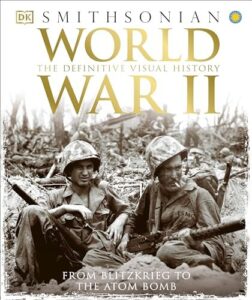
The verified listing tells us that this product is titled World War II: The Definitive Visual History from Blitzkrieg to the Atom Bomb, and that it comes from DK. The title clearly presents it as a broad, image-led history covering the conflict from its early German offensives through the atomic bomb. It does not, by itself, prove how much detail any one subject receives.
That distinction matters if you already own a specialist book on the Holocaust, the Eastern Front, the Pacific war or the political history of postwar Germany. A large overview can be an excellent starting point and still be inadequate as your only book on any one of those subjects.
Treating a broad visual history as a complete explanation of the war. A title can promise wide coverage without promising specialist depth, a full source apparatus or a sustained argument about disputed events.
Why this decision is harder than it looks
World War II is too large for a single simple narrative. The European war, the war in North Africa, the conflict in China, the Pacific campaign, the Holocaust, resistance movements and the postwar settlement overlap but do not move at the same speed. An account that follows only battlefield chronology can make political decisions look like military reactions. An account that follows only ideology can make operations such as the invasion of the Soviet Union or the bombing campaigns feel detached from the people who fought them.
Visual history books face another constraint: every photograph, map and caption has to carry a lot of weight. An image may show what a city looked like after bombing, but it cannot by itself explain who ordered the attack, what alternatives existed, or how historians know what happened. A map can clarify a front line while concealing the logistical problem behind it. A caption can be accurate and still too brief to explain why the event matters.
That is also why documentary comparisons can mislead. The World at War is associated with a 26-episode run released in 1973, according to The Guardian comparison cited in the research material. The newer World War II with Tom Hanks is described there as a 20-episode series, with Sky History as its broadcaster or platform context. Those are different works in different formats. Neither episode count tells you whether a book is better than either documentary.
Nor should the presence of Tom Hanks be treated as evidence about this DK title. The research material associates him with narration and appearances in the opening and closing of episodes of the series, and mentions his connection with Saving Private Ryan. That tells you about the television programme, not this book. The two products should not be merged in a recommendation.
The same caution applies to the date attached to the documentary coverage. The supplied research identifies a Guardian page dated May 26, 2026. That is a page-specific fact, not a verified publication date for the DK book. If you are choosing between the book and a programme, first establish which item you are actually buying or watching.
What the DK title promises—and what it does not
The strongest defensible reading of this product is that it is designed as a broad visual survey. That makes it potentially useful for readers who want a structured introduction, a reference work to browse, or a way to put familiar events into a larger sequence. It is likely to appeal to someone who learns more readily from timelines, photographs, maps and concise explanations than from a single long narrative. “Likely” matters here: the verified data confirms the visual-history positioning in the title, not the exact contents or design of the edition currently offered.
DK is the named brand and author in the supplied product data. That establishes who is responsible for the listing. It does not establish that every page was written by one historian, that the book includes named academic contributors, or that it carries a particular bibliography. Check the edition details before assuming any of those things.
The title’s range, “from Blitzkrieg to the Atom Bomb,” signals a start-to-finish frame rather than a narrow campaign study. For a new reader, that breadth is the main attraction. You can approach the war as a connected historical process: German expansion and the collapse of several European states; the widening conflict after attacks and declarations of war; the industrial and human cost of total war; genocide; the defeat of the Axis powers; and the political consequences left behind.
But a wide frame has a predictable cost. No overview can give equal space to the London Blitz, the Pearl Harbor attack, Operation Pike, the Holocaust, the Eastern Front, the Pacific war, strategic bombing, resistance, colonial troops and postwar Germany. If one of those subjects is your reason for buying, inspect the contents page and sample pages rather than relying on the word “definitive.”
There is a practical test. Ask what you want the book to do after you finish it.
- If you want a chronological foundation, a broad visual history may be a sensible choice.
- If you want to test a particular claim about Hitler or Pearl Harbor, you need notes and sources that let you trace the argument.
- If you want personal testimony, look for evidence of memoirs, oral histories or named eyewitness sources.
- If you want operational detail, look for maps with scale, dates, units and objectives rather than decorative battle diagrams.
- If you want an account of the Holocaust, confirm that the book treats it as a central history of persecution, mass murder and state policy, not as a short side panel.
Those are not criticisms of the DK book specifically. They are purchase tests prompted by the kind of book its title describes. Without edition-level information, a responsible review cannot claim that the book passes every test.
Before paying, open the live listing and check four things: the exact edition, the contents page, the sample pages and the format. Those details answer more than the word “definitive” can.
A sensible way to use a visual history
Use it first as a scaffold. Start with the chronology and mark the points where the war changes character: German expansion, the invasion of the Soviet Union, the widening of the conflict, the turning points in Europe and the Pacific, the systematic murder of European Jews, and the transition from military victory to occupation and reconstruction.
Then add depth selectively. You do not need another general survey immediately. Choose a specialist source for the subject that most affects your understanding. A reader interested in the Holocaust needs a work centred on Nazi persecution and genocide. A reader interested in the Pacific needs a study that can explain naval logistics, imperial politics and civilian experience. A reader interested in postwar Germany needs more than the final battle photographs.
This approach prevents a common reading failure: mistaking recognition for understanding. You may recognise a photograph of the London Blitz and still not understand the political choices surrounding bombing, evacuation, civil defence and propaganda. A visual guide is valuable when it helps you ask better questions. It is insufficient when it persuades you that seeing an image is the same as explaining an event.
How it compares with World War II documentaries
A book and a documentary solve different problems. A documentary controls pace. It can use archive footage, narration, music and expert interviews to create a continuous emotional experience. A book lets you stop, compare captions, reread a chronology and return to a map. That makes the DK title potentially better for reference, but not automatically better for immersion.
| What you need | A visual history book can offer | A documentary can offer | What to verify |
|---|---|---|---|
| Chronology | Pages you can revisit at your own pace | A sequence shaped by episode structure | How clearly dates and simultaneous fronts are shown |
| Visual evidence | Photographs, captions and possibly maps | Archive footage, sound and spoken context | Image credits, archival sources and caption quality |
| Interpretation | Written framing and editorial selection | Narration and expert interviews | Named authors, contributors and supporting sources |
| Depth | Easy to pause and cross-reference | Limited by running time and episode focus | Contents, page allocation or episode descriptions |
| Accessibility | Read in short sessions and consulted as needed | Useful for viewers who learn through sound and moving images | Format, text size, subtitles, audio description and availability |
The comparison with The World at War needs care. The supplied research describes that documentary as a 26-episode series released in 1973. It describes World War II with Tom Hanks as a 20-episode series in the Sky History context. A 20-episode series can feel basic rather than epic if each episode has to move quickly through a huge amount of material. A 26-episode structure can create more room, but age, production choices and historical framing still matter. Episode count is a scheduling fact, not a quality rating.
Archive footage adds immediacy, but it also requires explanation. The camera position, original purpose, missing material and later editing all affect what viewers think they are seeing. Narration can connect a date to a consequence. It can also compress debate into a confident sentence. Expert interviews are useful when the contributors are identified and their claims are placed against evidence. A string of unnamed authorities is much harder to assess.
The book’s equivalent of documentary narration is editorial design: the order of pages, the size given to an image, the wording of a caption and the choice of map. Those choices shape interpretation even when the prose appears neutral. A photograph of Hitler, a map of the Western Front or an image from the Blitz is never the whole event. The reader should ask what appears beside it and what has been left out.
For that reason, this DK title suits a different viewing or reading plan than a Tom Hanks series. Use the series, if you choose it, for a guided audiovisual overview. Use the book for pauses, cross-checking and visual recall. Do not assume that the book contains the series’ narration, archive selection or expert contributors. The verified product information does not say that it does.
A chronology that keeps the major claims in proportion
The most useful way to judge any overview is to see whether it preserves connections between events. Here is the minimum framework a general reader should carry into the book or a documentary.
Hitler and the road to war
Hitler’s dictatorship was not simply a military machine waiting for a battlefield. Nazi ideology joined racial persecution, territorial expansion, political repression and the destruction of democratic institutions. A reliable overview should connect foreign policy to that ideology rather than presenting the war as a sequence of clever manoeuvres by a conventional statesman.
That does not mean every decision had one cause. Strategic calculation, economic pressure, institutional rivalry and ideological goals could operate together. Be wary of explanations that reduce the conflict to one hidden plan or one heroic individual. Ask what evidence supports the claim and whether the same source distinguishes documented policy from later speculation.
The London Blitz and civilian experience
The London Blitz belongs in both military and social history. Bombing affected civilians, infrastructure, morale and political choices. A photograph of damaged streets makes the destruction visible, but it does not settle debates about effectiveness, proportionality or retaliation. A good account should distinguish what happened from arguments about what leaders intended and what bombing achieved.
Look for dates, locations and a clear explanation of the wider campaign. A caption that says only “London after the Blitz” gives atmosphere but little history. A useful map or timeline should show how the bombing fits into the war rather than treating it as an isolated national ordeal.
Pearl Harbor and the widening war
The Pearl Harbor attack is often presented as a single turning point. It was a turning point, but it sits inside a larger chain of conflict in Asia, American-Japanese relations and decisions made before December 1941. A broad history should explain what changed after the attack without implying that all previous tensions began that morning.
This is an area where popular retellings can become conspiratorial. The fact that governments made mistakes, withheld information or later defended their actions does not prove that every warning was deliberately ignored or that a secret plan caused the attack. Separate established evidence, plausible interpretation and unsupported allegation.
Operation Pike and the danger of isolated anecdotes
Operation Pike is a useful test of editorial judgement because it is less familiar to many general readers. The name refers to British and French planning for possible attacks on Soviet oil facilities during the early period of the war. Its significance depends on context: the diplomatic situation, the wider conflict and the difference between planning, preparation and execution.
A careful overview should not present a plan as though it became a completed campaign. It should identify what was proposed, why it was considered and what happened to the plan. This is precisely the kind of subject where a short caption can create a false impression if it removes the surrounding chronology.
The Holocaust
The Holocaust cannot be treated as a mystery produced by wartime chaos. Nazi persecution developed through laws, exclusion, dispossession, forced movement, ghettos, mass shootings, deportations and killing centres. The sequence, institutions and victims matter. So does the distinction between the Holocaust and the wider category of wartime atrocities, even though they occurred within the same conflict.
When evaluating a general history, check whether the Holocaust is integrated into the main chronology or confined to a brief box. Check whether the language identifies perpetrators, policies and victims clearly. Claims that minimise, relativise or turn the Holocaust into a vague symbol should not be given equal status with documented historical evidence.
Postwar Germany and the atom bomb
The war did not end when fighting stopped. Occupation, displacement, trials, political division, reconstruction and the treatment of former officials shaped postwar Germany. An overview that ends with victory photographs may leave readers unable to understand how the conflict became the foundation of a new political order.
The atom bomb also needs more than a dramatic final image. A responsible account should place the bombings in the context of the Pacific war, military planning, Japanese surrender, American decision-making and the emerging postwar balance. Readers should be able to distinguish documented facts from the continuing debate over motives and alternatives.
How to handle revisionist claims
Revision is a normal part of historical scholarship. Historians revise interpretations when new archives, testimony or methods change the evidence. “Revisionist” becomes a warning sign when it is used to suggest that established evidence should be dismissed simply because an argument sounds contrarian.
The research material names Ron Unz, Mike Whitney and The Unz Review in connection with revisionist claims. Their inclusion in a search result does not make their claims reliable, and it does not allow this review to attribute a specific argument to either writer without the relevant article and evidence in front of us. That restraint is necessary. A name is not a source evaluation.
Use five questions before accepting a dramatic claim about Hitler, Pearl Harbor, the London Blitz or the Holocaust:
- What exactly is being claimed? “The government knew more” is too vague to test.
- What primary evidence is offered? Look for documents, dates, provenance and a clear chain from source to conclusion.
- Does the claim distinguish knowledge from intention? Knowing that an attack might occur is not the same as arranging it.
- Does it address contrary evidence? An argument that quotes only favourable material has not completed the test.
- Is the claim proportionate to the evidence? A disputed detail cannot automatically overturn an entire field of research.
This method is especially important with the Holocaust. Disagreement about a number, document or chronology can be legitimate historical work. Denying or minimising the organised nature of Nazi persecution and mass murder is not made credible by presenting itself as forbidden knowledge. The burden of proof rises with the scale of the claim.
The same standard applies to documentaries. Archive footage can be authentic and still be edited to support a misleading interpretation. A confident narrator can make a controversial thesis sound settled. An interview can contain a genuine expert’s opinion without proving every conclusion drawn around it.
For this DK book, the practical question is whether the edition gives you enough sourcing to check its framing. Look for a bibliography, notes, image credits, named contributors and a distinction between primary evidence and later interpretation. The supplied product data does not confirm the presence or absence of those features, so verify them rather than assuming.
✅ Worth considering if...
You want a broad, visual starting point for the war, prefer a reference book you can browse, and are willing to check the edition details before buying.
❌ Skip it if...
You need a specialist study, a fully documented argument about a disputed claim, or a confirmed audiobook, page count or contributor list that the available listing does not provide.
Who should buy it—and who should wait
This is a promising fit for a reader who wants orientation. You may be trying to place the Blitz beside the Eastern Front, understand how the Pacific war fits into the wider conflict, or remember which events led toward the defeat of Nazi Germany and the postwar settlement. A visual survey is often less intimidating than a dense specialist monograph. It can also work well as a shared family reference, provided an adult supplies context for the most difficult subjects.
It is less suitable as a standalone authority for a serious research project. The title’s breadth is a clue. If your purpose is to write about one campaign, verify a disputed interpretation or study the Holocaust in depth, you need a source base designed for that purpose. This book may still be useful as an orientation tool, but it should not carry the whole argument.
Age suitability cannot be responsibly stated from the supplied data. The subject includes genocide, mass death, civilian bombing and nuclear warfare. Check the publisher’s description, sample pages and any age guidance before buying it for a younger reader. “Visual” does not mean gentle.
Accessibility also needs checking at edition level. The verified data does not tell us whether the listing is for a print book, ebook, audiobook or another format. It does not confirm subtitles, audio description, text size, image descriptions or screen-reader support. If you need one of those features, confirm it on the live product page rather than inferring it from the title.
Availability is clearer: the supplied product data marks the item as IN_STOCK. Price is not stable enough to state as a permanent figure. Compare the current listing with comparable general histories and decide whether the visual format earns its premium for you. The right benchmark is not the cheapest war book. It is the cost of getting the breadth, design and usability you actually need.
| Your priority | Decision | Why |
|---|---|---|
| A first organised overview | Consider it | The title’s broad visual-history positioning matches that use. |
| A quick reference for names and sequence | Consider it after checking samples | Contents, captions and index quality will determine its usefulness. |
| Deep research on one campaign | Pair it with a specialist book | A wide survey cannot reliably replace focused scholarship. |
| Fact-checking revisionist claims | Check the notes and bibliography first | Strong sourcing matters more than an authoritative design. |
| An audiobook or narrated documentary | Do not assume it is included | The verified listing does not confirm the format. |
| A younger reader | Check age guidance and sample pages | The subject matter includes extreme violence and genocide. |
Verdict: worth the money?
My verdict is conditional rather than inflated. World War II: The Definitive Visual History from Blitzkrieg to the Atom Bomb is worth considering if what you need is a broad DK reference built around the idea of visual history. Its likely value lies in giving a reader a coherent starting frame for a huge subject, not in replacing specialist scholarship or settling every disputed interpretation.
I would not buy it solely because the title says “definitive.” I would not use the Tom Hanks series, The World at War, or a claim from Ron Unz, Mike Whitney or The Unz Review as evidence about the book’s contents. Those are separate sources and products. Compare them by purpose: the book for browsing and reference, a documentary for guided audiovisual storytelling, and specialist scholarship for evidence-heavy questions.
The missing information is not a minor technicality. Edition, format, contents, sample pages, sourcing and current price determine whether this particular listing earns your money. Check those details on the live page. If they match your needs, the book has a sensible role in a personal World War II library. If you need deep documentation or a confirmed listening experience, choose a more specific product instead.
✅ Pros
- Broad subject range signalled by the title
- Visual-history positioning may suit browsing and first-time learners
- In stock according to the verified listing
❌ Cons
- Edition details are not verified here
- No confirmed page count, format, contributors or sourcing information
- A broad survey should not replace specialist histories
Is World War II: The Definitive Visual History the same as World War II with Tom Hanks?
No. The verified product is a DK title. World War II with Tom Hanks is a separate documentary series discussed in the research material, so do not assume the book contains its narration, episodes or archive footage.
How does it compare with The World at War?
They are different formats. The supplied research describes The World at War as a 26-episode documentary released in 1973, while the Tom Hanks series is described as a 20-episode production. Those episode counts do not establish the quality or contents of the DK book.
Does the book cover Hitler, the Blitz, Pearl Harbor and the Holocaust?
The title presents a broad history of World War II, but the supplied product data does not provide a contents list. Check the edition’s contents and sample pages before assuming how much space any one subject receives.
Are claims by Ron Unz and Mike Whitney reliable?
A writer’s name is not enough to establish reliability. Check the exact claim, the primary evidence, the treatment of contrary evidence and whether the conclusion is proportionate to the sources. Do not treat a revisionist claim as established simply because it challenges a familiar account.
Is this available as an audiobook?
The verified data confirms that the product is in stock, but it does not confirm the format. Check the live listing for the edition and delivery method you want.
Is it worth buying if I already own a general World War II history?
Only if the visual-reference format adds something you will use. If your existing book already supplies maps, photographs and a clear chronology, a specialist study may offer better value for your next purchase.
Check the live listing for the current edition, format and price